

Best Way To Study For Tableau Desktop-Specialist Exam Brilliant Desktop-Specialist Exam Questions PDF
Updated Verified Pass Desktop-Specialist Exam - Real Questions & Answers
How to study the Tableau Desktop-Specialist: Tableau Desktop Specialist Exam
A wide variety of Tableau Desktop-Specialist dumps have been recognized for qualification concerns for Tableau Certified Developer-Professional Certifications. The fact that students have to study carefully doesn’t facilitate certificates. The training from Tableau Accredited Developer-Professional often takes a long time. Each test contains answers and questions that allow students to pass their final test. After taking and studying our courses, you can pass the exam. But it doesn’t stop there; you can always be successful with your profession thanks to our complete guides. In the future, you will manufacture your own merchandise. We have an innovative approach to preparing some content for you. We also applied the new data to production and commodities.
NEW QUESTION 46
Which of the following is NOT a valid official data source in Tableau Desktop?
- A. Google Firebase
- B. Amazon Redshift
- C. SAP HANA
- D. PostgreSQL
Answer: B
Explanation:
Explanation
Presently, there is no official way to connect your data in Firebase directly with Tableau Desktop.
A workaround however can be to export your Firebase data into Google BigQuery, and then connect it to Tableau Desktop.
But then again, it is a workaround and not an official out-of-the-box solution.
The following are the available Data sources available as of now:
* Server
* File
NEW QUESTION 47
Broadly speaking, when users connect to Tableau, the data fields in their data set are automatically assigned a
____________ and a ____________.
- A. Data type, Value
- B. type, role
- C. dimension, measure
- D. role, type
Answer: D
Explanation:
Explanation
When users connect to Tableau, the data fields in their data set are automatically assigned a role and a type.
Role can be of the following two types:
1) Dimension
2) Measure
Type can be of the following :
1) String
2) Number
3) Geographic
4) Boolean
5) Date
6) Date and Time
NEW QUESTION 48
Which of the following are interactive elements that can be added to a dashboard for users?
- A. Highlight Action
- B. Edit Tooltip Action
- C. URL Action
- D. Filter Action
Answer: A,B,C
Explanation:
Explanation
We can perform filter, URL and highlight actions out of the above given choices on a dashboard. Please refer to the image below: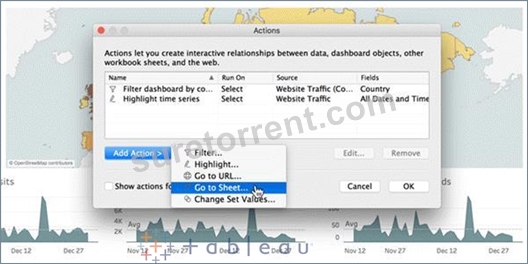
NEW QUESTION 49
________________ can only create header. _______________ will create header and axis both.
- A. Dates, Strings
- B. Dimensions, Measures
- C. Measures, Dimensions
- D. Groups, Sets
Answer: B
Explanation:
Explanation
Using the Sample superstore as a reference:
1) Let's plot a bar chart showing SUM(Quantity) for each Segment:
2) Right click on the x-axis (Segment):
Notice we don't have an option to edit the axis, only header. This is because only continous values form the AXIS.
3) Similarly, right click on the y-axis (Quantity):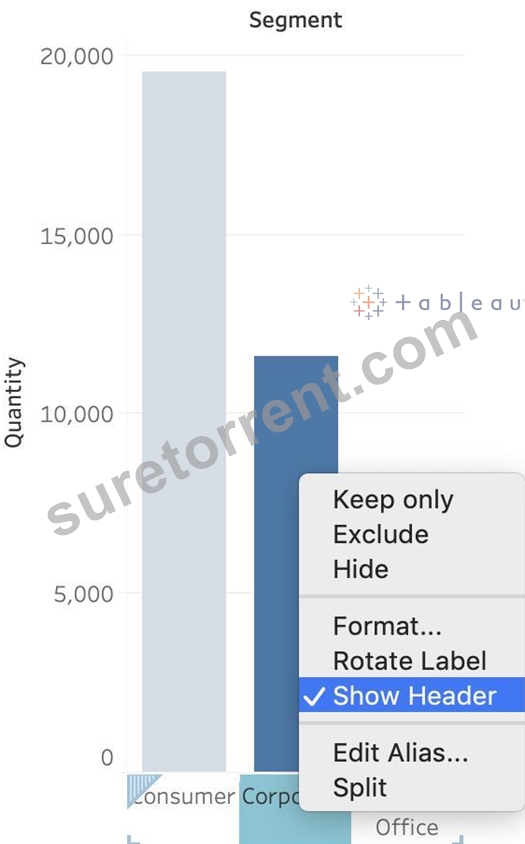
Now we have the option to edit BOTH the axis and the header.
NEW QUESTION 50
Which of the following is a benefit of using a Tableau Data Source (.tds)?
- A. To hold one or more worksheets, plus zero or more dashboards and stories.
- B. To create a local copy of a subset or entire data set that you can use to share data with others, when you need to work offline, and improve performance.
- C. To not contain the actual data but rather the information necessary to connect to the actual data as well as any modifications you've made on top of the actual data such as changing default properties, creating calculated fields etc
- D. To create a single zip file that contains a workbook along with any supporting local file data and background images. This is great for sharing your work with others who don't have access to the original data.
Answer: C
Explanation:
Explanation
The following are the official definitions from the Tableau documentation for the various file types:
1) .tds (Tableau Data Source) - To not contain the actual data but rather the information necessary to connect to the actual data as well as any modifications you've made on top of the actual data such as changing default properties, creating calculated fields etc. (CORRECT ANSWER)
2) .twbx ( Tableau packaged workbook) - To create a single zip file that contains a workbook along with any supporting local file data and background images. This is great for sharing your work with others who don't have access to the original data.
3) Extract (.hyper or .tde) - To create a local copy of a subset or entire data set that you can use to share data with others, when you need to work offline, and improve performance.
3) (.twb) Workbooks - To hold one or more worksheets, plus zero or more dashboards and stories.
NEW QUESTION 51
Download the Dataset from:
https://drive.google.com/file/d/12AYHfiPWkwBmvH0zbumOURgUX6Az00Rw/view?usp=sharing Using the Time Series Table, create a line chart to show Sales over time. Which Month and Year witnessed the lowest Sales?
- A. September 2017
- B. January 2018
- C. March 2018
- D. December 2017
Answer: B
Explanation:
Explanation
Follow the steps to get the correct answer : January 2018
* We are talking about dates, so use the Time series sheet as follows:
* Next, the following should be your view and clearly, January 2018 is the lowest point: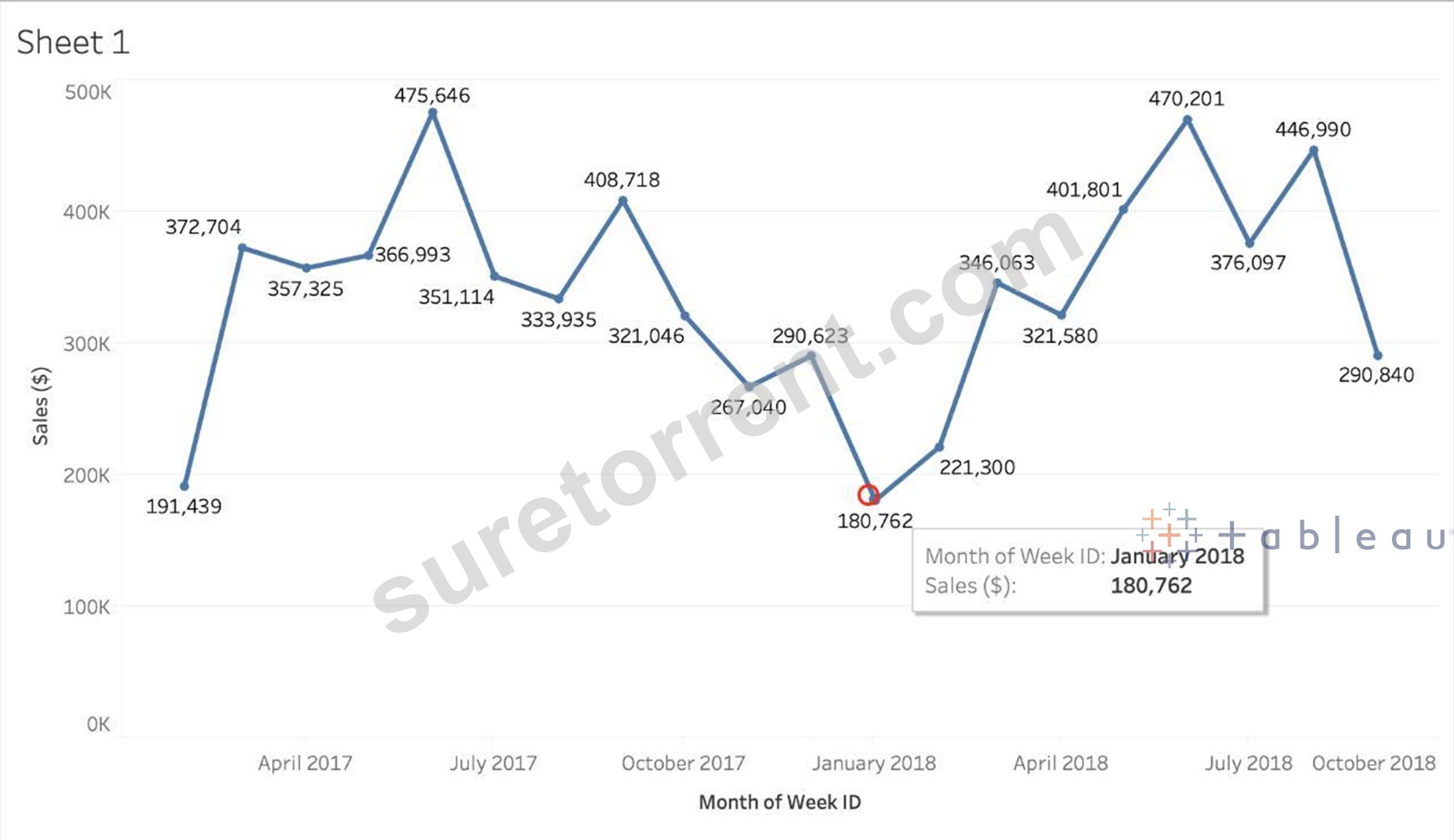
Read more about dates:
https://interworks.com/blog/rcurtis/2017/01/30/tableau-deep-dive-dates-introduction-dates/
NEW QUESTION 52
A field that shows average home values for the United States in 2016 is most likely :
- A. A geographical dimension
- B. A continuous date value dimension
- C. A discrete date part dimension
- D. An aggregated measure
Answer: D
Explanation:
Explanation
This question is directly from the Official Tableau Desktop Specialist exam guide.
Since we are talking about the AVERAGE home values for the United States in 2016, the question is directly offering us a hint that the answer has something to do with aggregation and that too the values tell us that we're working with MEASURES.
Date part and Date values don't really make much sense given the question, and neither does geography.
Therefore, the answer naturally is "An aggregated measure".
NEW QUESTION 53
Which of the following is a compelling reason to export a sheet in Tableau to a PDF?
- A. If we want a static view of the visualisation.
- B. If we want to use filters in the visualisation.
- C. If we want to dynamically enter parameters to the visualisation.
- D. If we want to interact with the visualisation.
Answer: A
Explanation:
Explanation
Exporting the visualisation gives us a static view of the visualisation.
It is NOT possible to interact with it, use filters, or dynamically enter anything in a visualisation exported PDF.
In Tableau Desktop, you can save views as PDF files rather than printing them as hard copies. You do not need to have Adobe Acrobat installed on your computer.
When you print an individual sheet to PDF, filters in the view are not included. To show filters, create a dashboard containing the sheet and export the dashboard to PDF. (IMPORTANT)
NEW QUESTION 54
_________________ is useful when you need to change how the data source is configured on a sheet-by-sheet basis, and when you want to combine databases that don't allow relationships or joins
- A. Data Joining
- B. Data Blending
- C. Union
- D. Data segregation
Answer: B
Explanation:
Explanation
Data blending is performed on a sheet-by-sheet basis and is established when a field from a second data source is used in the view. To create a blend in a workbook already connected to at least two data sources, bring a field from one data source to the sheet-it becomes the primary data source.
Switch to the other data source and use a field on the same sheet-it becomes a secondary data source. An orange linking icon will appear in the data pane, indicating which field(s) are being used to blend the data sources.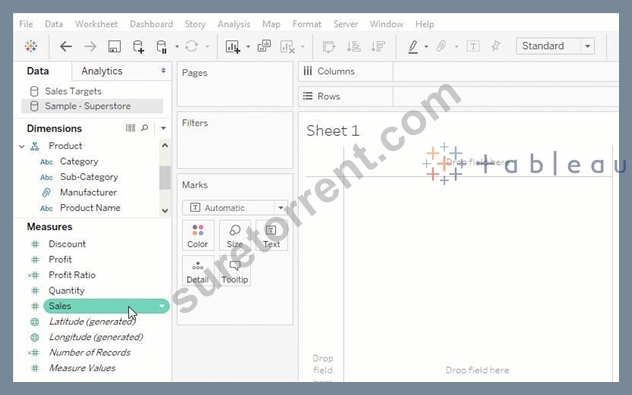
According to the official Tableau Documentation: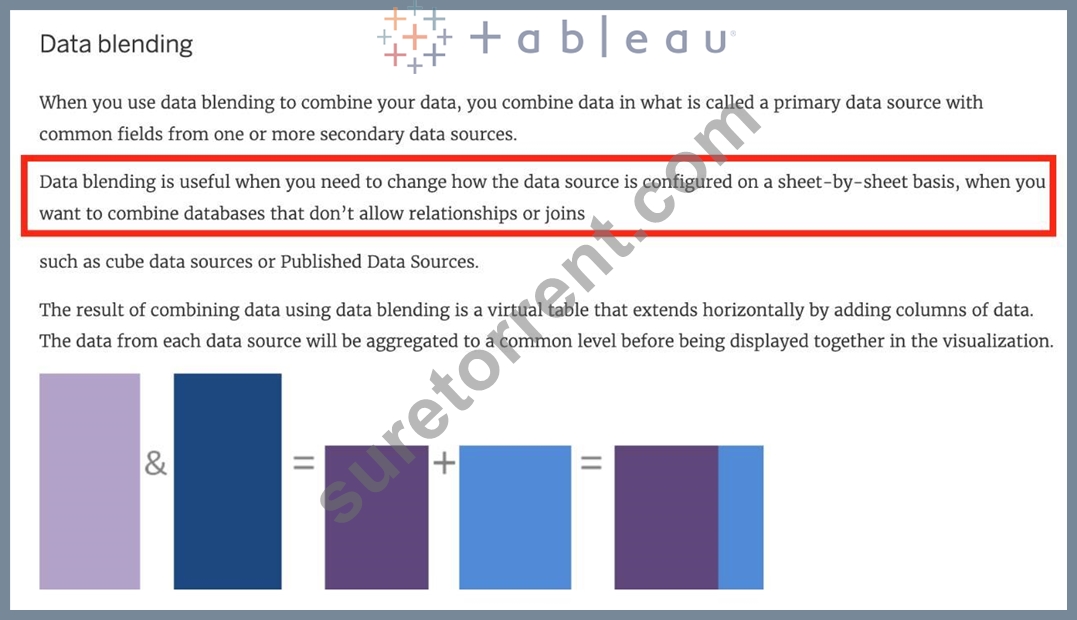
To read more about Data Blending, click on THIS link.
NEW QUESTION 55
Which of the following 2 columns CANNOT be deleted in Tableau?
- A. Measure Values
- B. Measure Names
- C. Number of Records
- D. Calculated Fields
Answer: A,B
Explanation:
Explanation
Measure names and values CANNOT be deleted in Tableau like other columns can. These are auto-generated.
Calculated Fields, and Number of records can both be deleted.
NEW QUESTION 56
Which of the following are valid ways of Grouping Data?
- A. From the Dimensions Shelf
- B. Using Marks in the view
- C. From the Analytics Pane
- D. Using Labels in the View
Answer: A,B,D
Explanation:
Explanation
**IMPORTANT QUESTION AND EXPLANATION, PLEASE READ**
3 ways to group data -
1) Marks
2) Labels
3) Dimensions shelf.
*IMPORTANT*
If we Group the data by selecting the marks, then they remain separate marks in the view and then have the same colour. Also, a new group is created in the Dimensions shelf. Example - Using the sample superstore dataset, first plot a bar chart showing sales for each sub-category: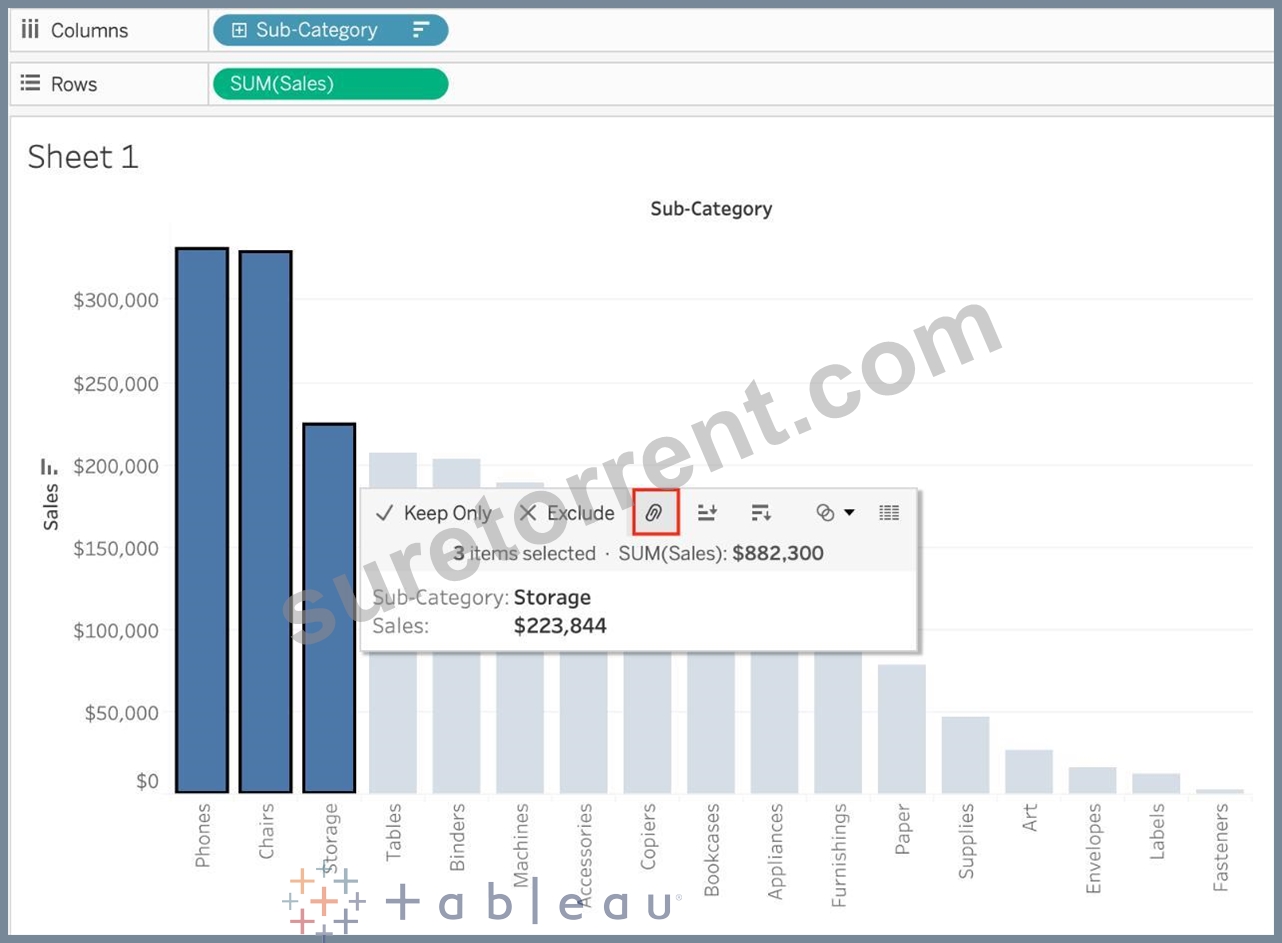
Here, if we Select Phones, Chairs and Storage by selecting the MARKS (Bars), and then group them: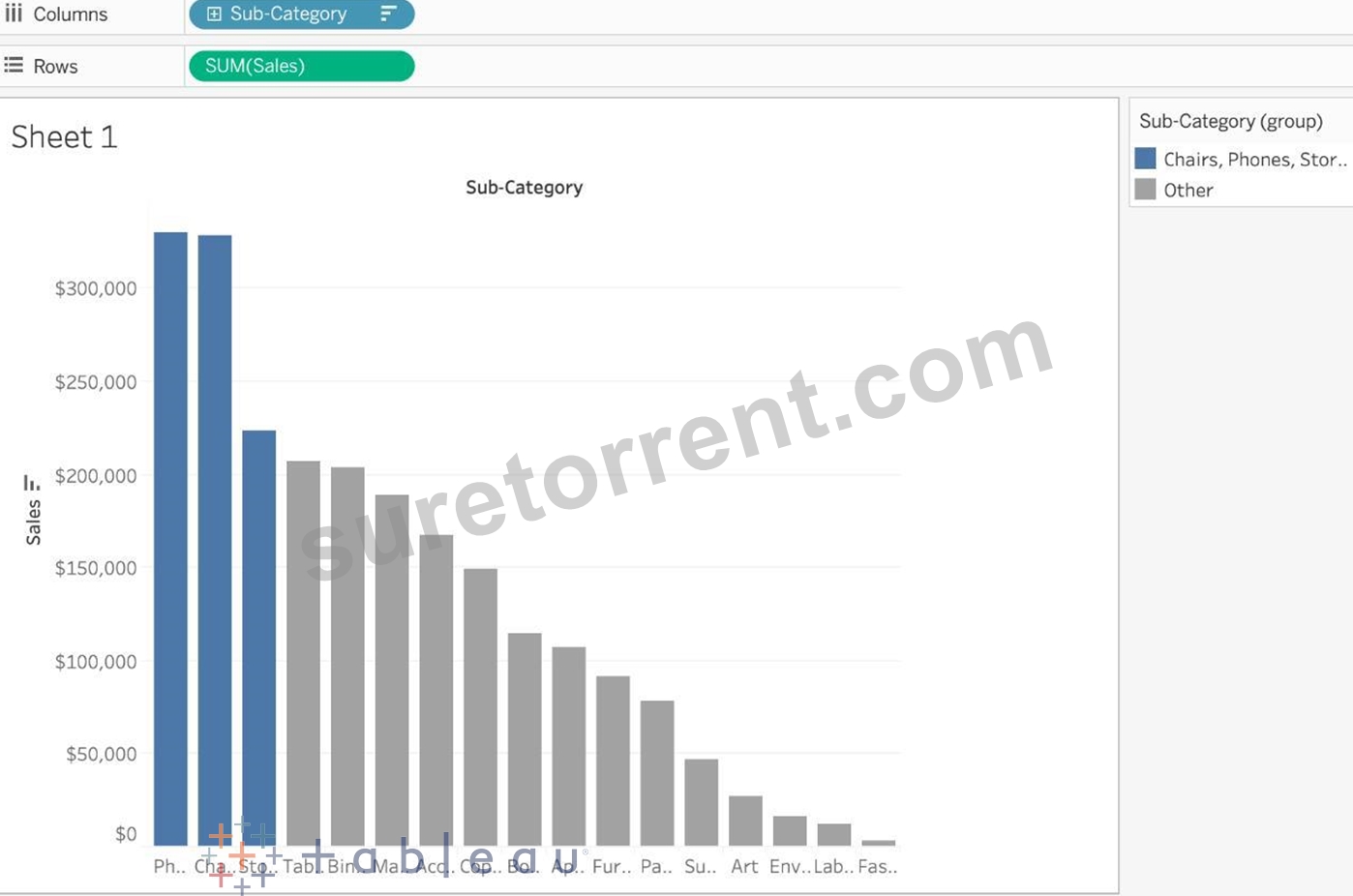
They remain seperate marks (BARS) but are grouped by the same colour.
Now, if we didn't do this, and rather grouped by selecting their Labels (Names):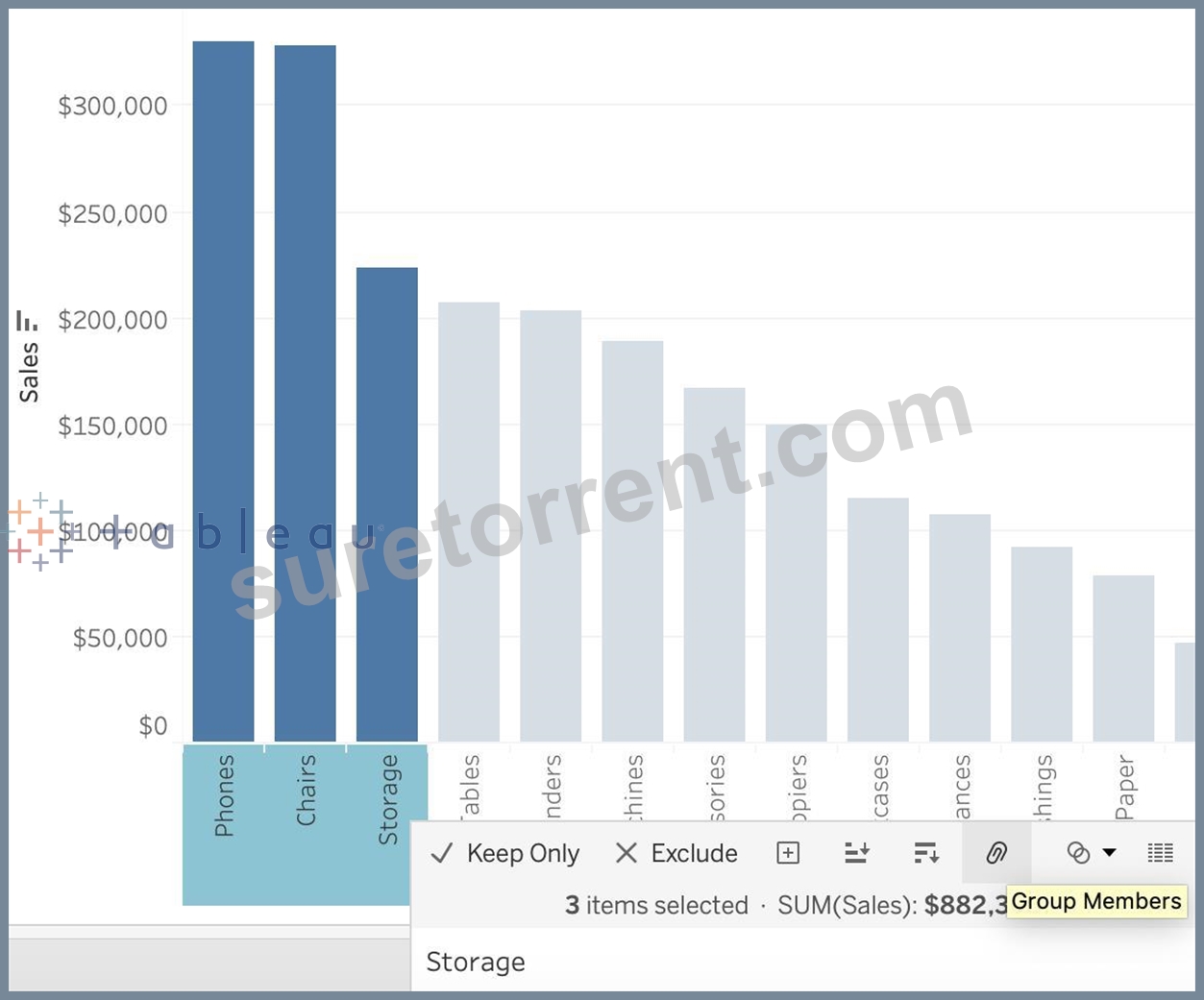
Then they no longer remain separate Marks (bars) but are rather consolidated into a single Bar: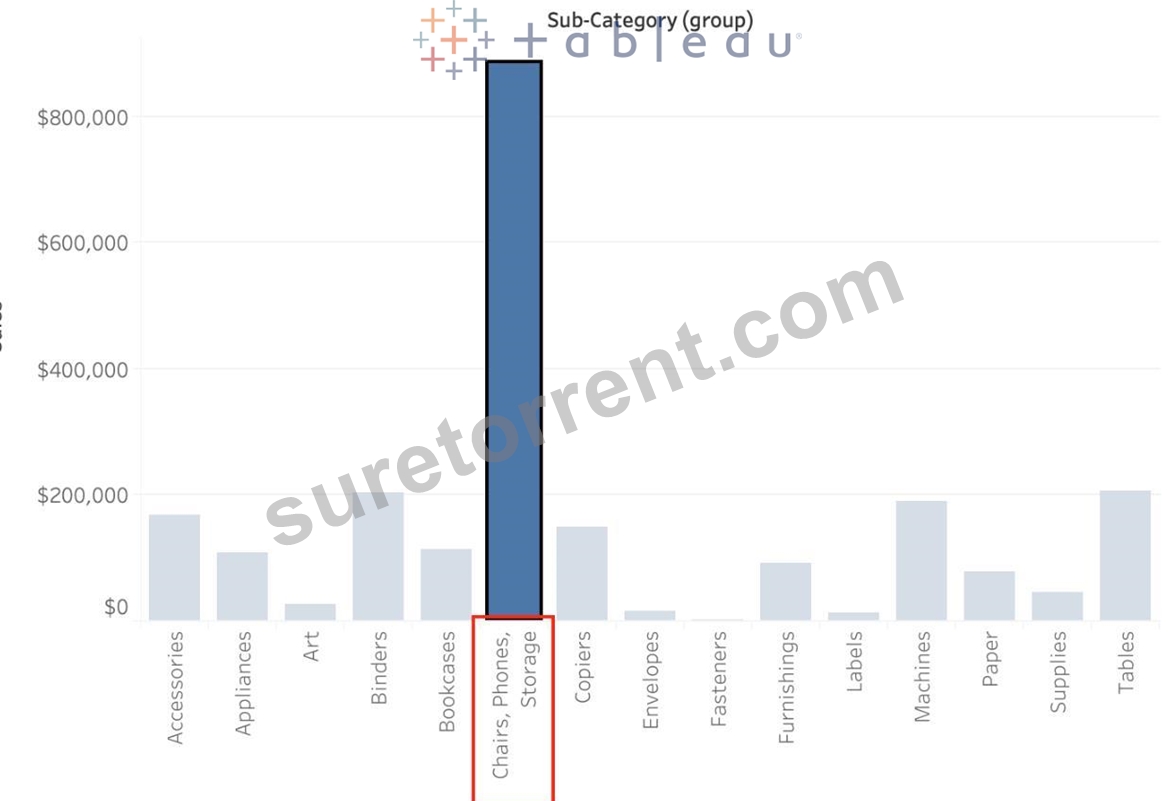
Finally, we can group directly from the Dimensions shelf as follows: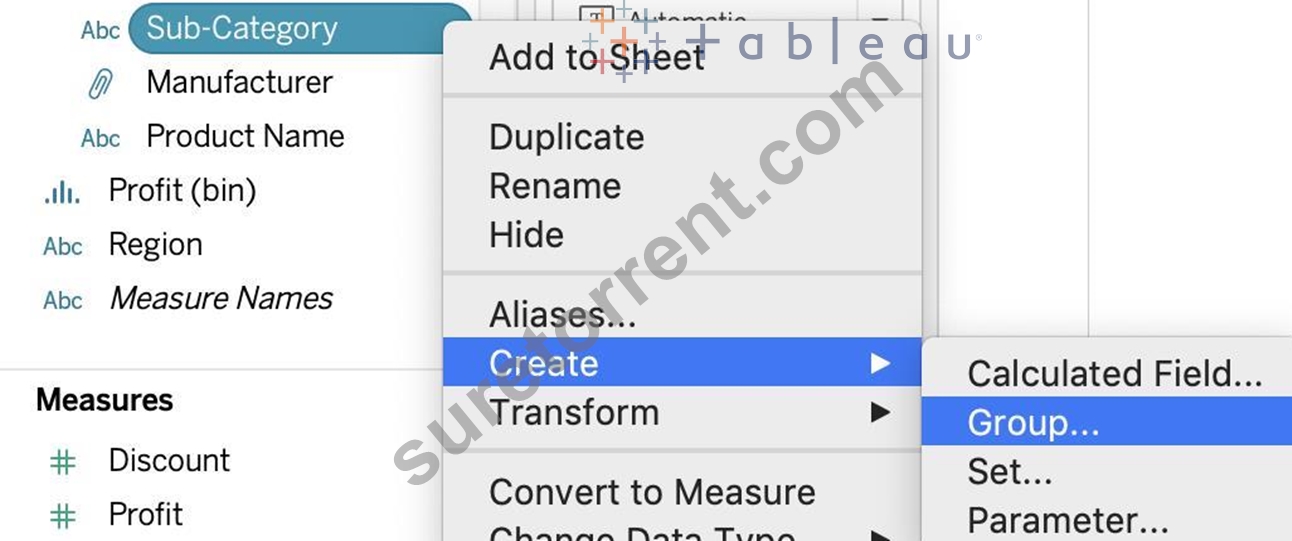
Now choose Phones, Chairs and Storage and Click Group: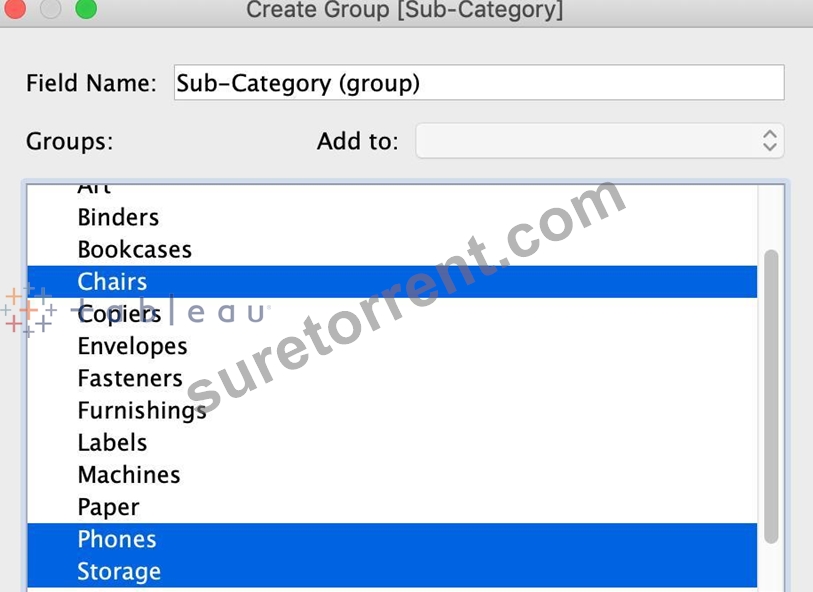
You will now automatically have a new Dimension as follows:
NEW QUESTION 57
Using the CoffeeChain table, create a chart to see the monthly Percent difference change in Profit, from the beginning of 2012 to the end of 2013. How many months saw a Negative percent difference in Profit?
- A. 0
- B. 1
- C. 2
- D. 3
Answer: B
Explanation:
Explanation
Follow along to reach the correct answer:
1) First, drag Date to the Column shelf and Profit to the Rows shelf. We need to see the 2 consecutive months over this two year period (2012-2013) so this tells us we need to work with continuous dates:
Click on Date in the Column shelf and convert it to continuous month :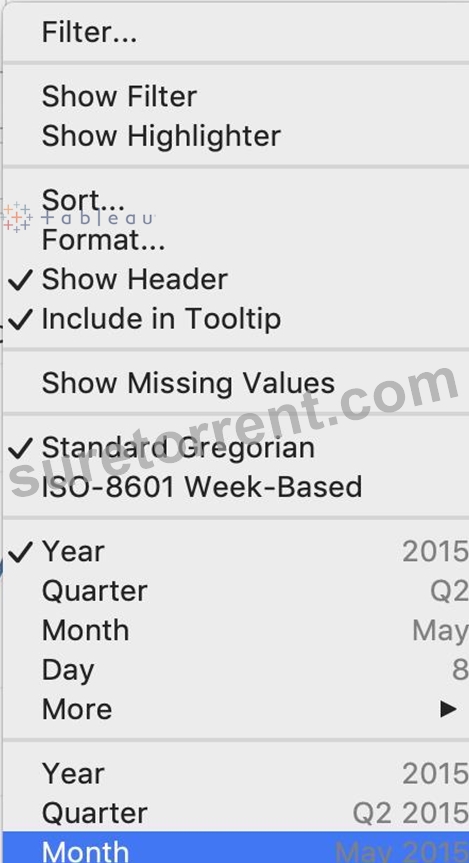
2) Now, click on the Profit pill in the Rows shelf, go to quick table calculation and choose Percent difference: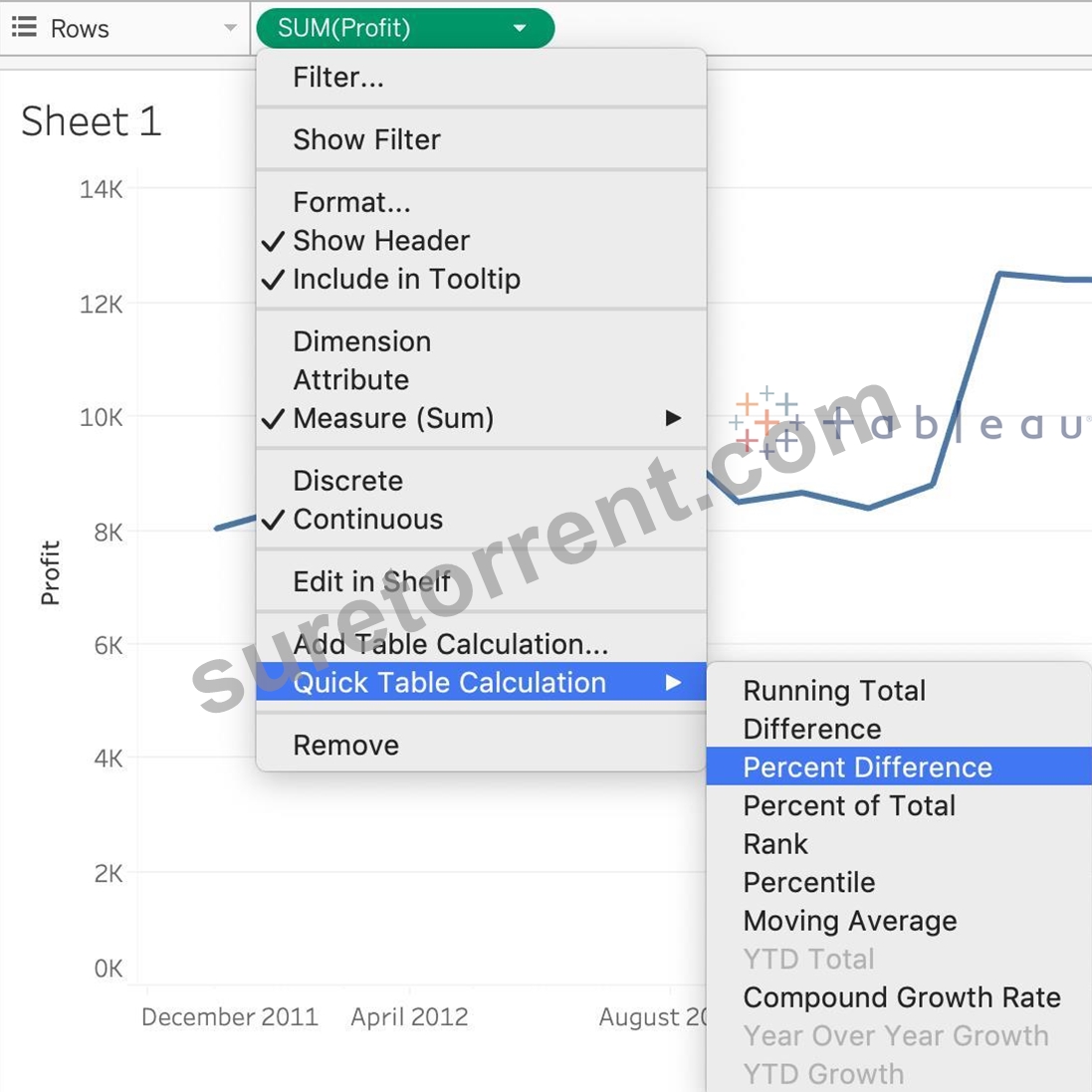
3) Finally, click on the Show mark Labels icon:
4) We finally have our view, and clearly, 10 Months have a NEGATIVE percent difference: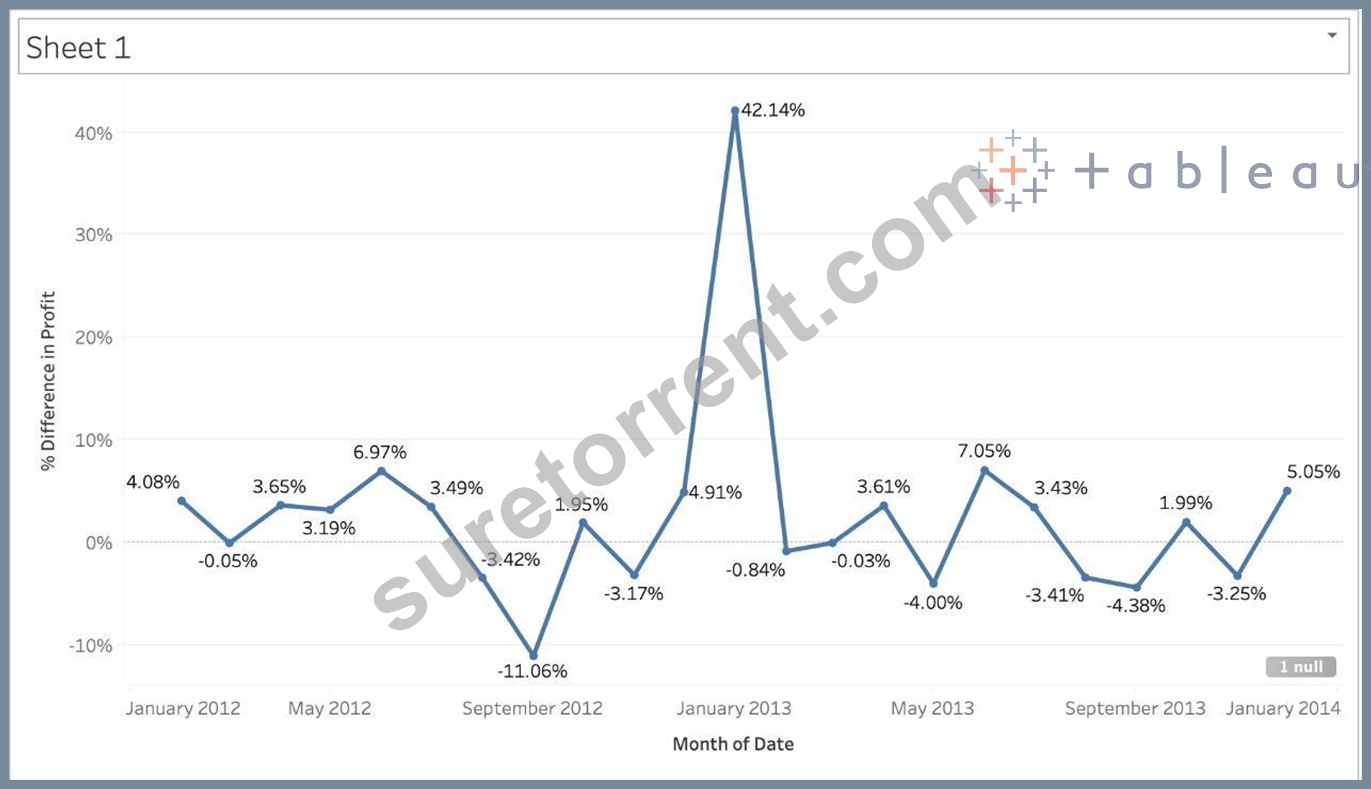
NEW QUESTION 58
______________ refers to the level of detail for a piece of data, wherever you are looking.
- A. Data granularity
- B. Data connectivity
- C. Data LOD
- D. Data Cleanliness
Answer: A
Explanation:
Explanation
Data is generated and analyzed at many different levels of granularity. Granularity is the level of detail of the data. For example, when looking at graduation data, granularity would describe whether a row in the data set represents a single person or the graduating class of a university.
NEW QUESTION 59
According to Tableau's 'Order of Operations', which of the following filters is applied FIRST?
- A. Context Filter
- B. Extract Filter
- C. Dimension Filter
- D. Measure Filter
Answer: B
Explanation:
Explanation
According to Tableau's order of operations, the Extract filter is right at the top of the hierarchy. The data filtered in the Extract is then passed on to what we see in the Data Pane. See below: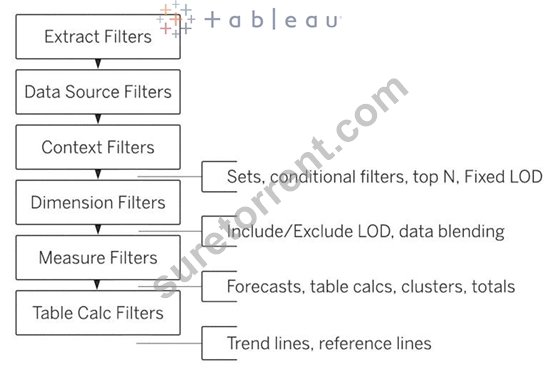
NEW QUESTION 60
Larger image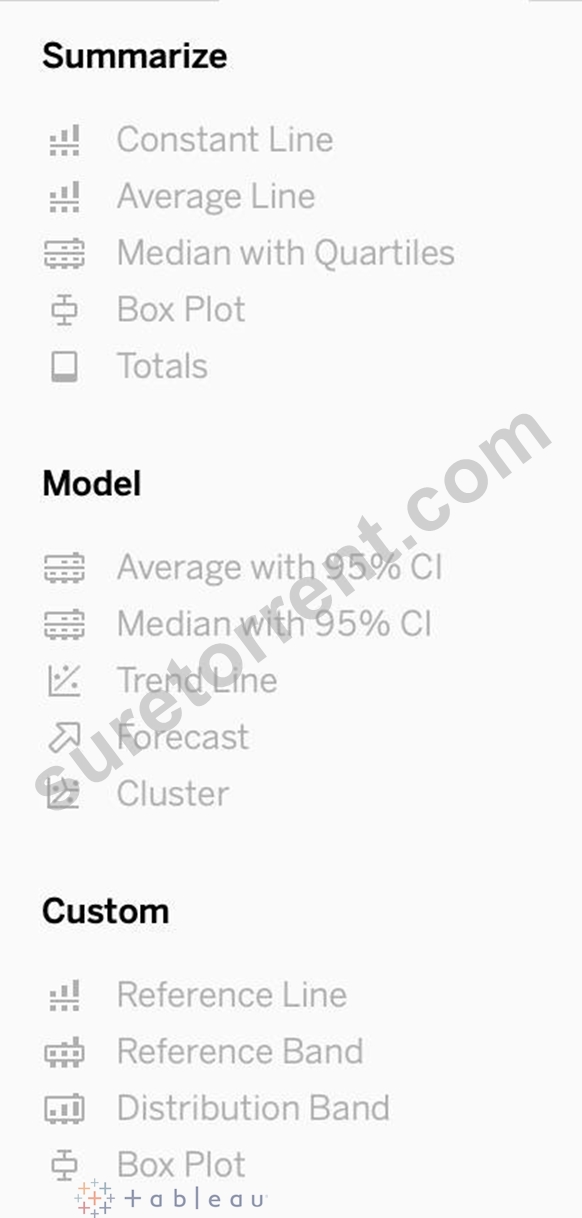
What is this entire view referred to as in Tableau?
- A. Analytics Pane
- B. Summary Pane
- C. Data pane
- D. Distribution Pane
Answer: A
Explanation:
Explanation
Distribution Pane
Explanation
This is the Analytics pane! Read more from the official documentation below: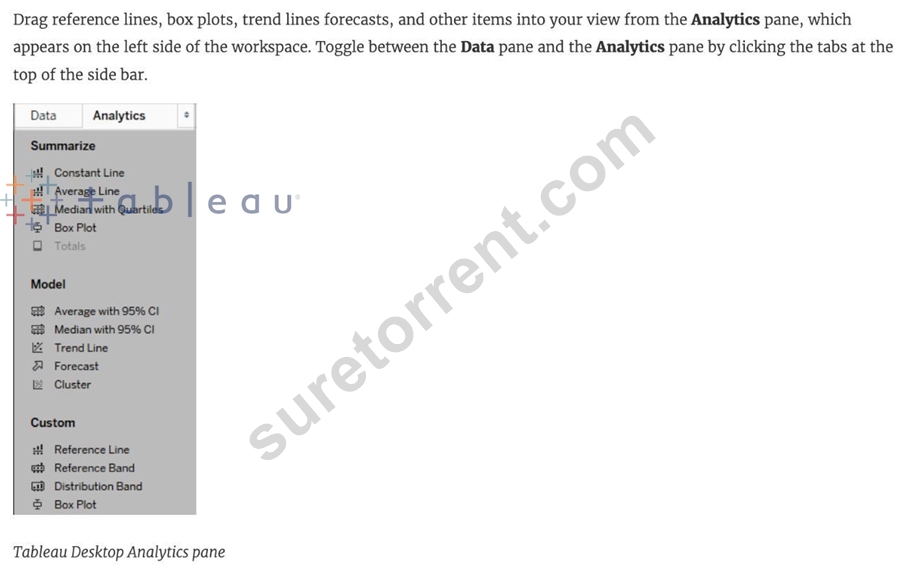
NEW QUESTION 61
For a relative date filter, the default anchor is _________________
- A. The date we specify
- B. Today's date
- C. The target date
- D. The current time
Answer: C
Explanation:
Explanation
Relative date filters dynamically update to show a time period relative to when you open the view, such as the current week, the year to date, or the past 10 days. Relative date filters make it easy to create views that always show the most recent data.
Step 1: Drag a date field to the filter shelf
Right-click (control-click on Mac) and drag a date field from the Data window to the Filters shelf. In the Filter Field dialog box, click Relative Date, and then click Next.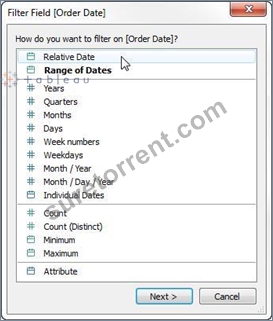
Step 2: Select a time unit
In the Filter dialog box, click Relative dates, and then select the unit of time for the filter. For example, to show only the three most recent weeks, select Weeks.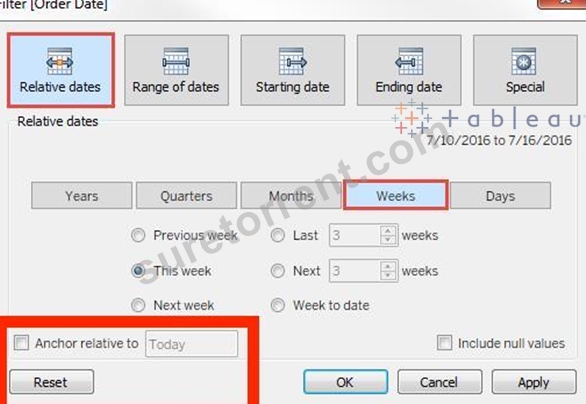
Here, you can clearly see that the default date is TODAY
NEW QUESTION 62
What does the following icon do in Tableau?
Larger image
- A. Create a Story and Dashboard both
- B. Create a Worksheet
- C. Create a Story
- D. Create a Dashboard
Answer: D
Explanation:
Explanation
The icon shown is used to add a new Dashboard! From the official documentation: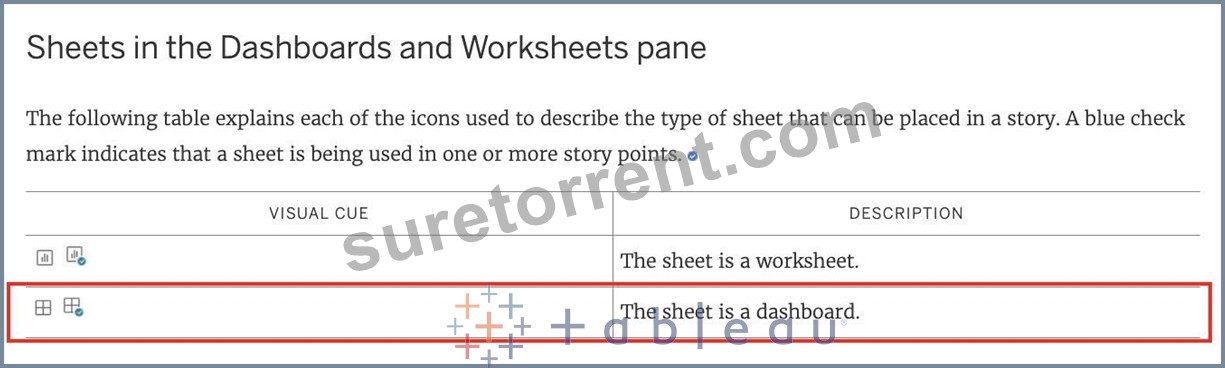
NEW QUESTION 63
Using the dataset provided, create a crosstab showing the Profit of each Region per Year, then add grand totals to the view. What was the total Profit for Canada in 2012 and the total Profit for Canada for 2011 through
2014, respectively?
- A. 4,888 and 17,817
- B. 1,807 and 34,571
- C. 52,678 and 311,404
- D. 5,129 and 88,872
Answer: A
Explanation:
Explanation
To reach the correct answer, follow these steps:
1) Drag Order Date (Discrete Year) to the Column shelf, and Region to the Row Shelf as shown: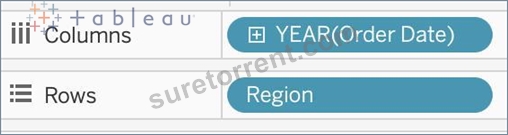
2) Drag Profit to Text in the Marks Shelf as shown: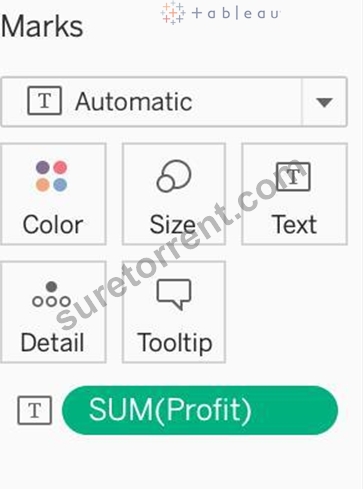
3) Click on Analysis as shown -> Totals -> SELECT ROW GRAND TOTALS
The following will be the final view: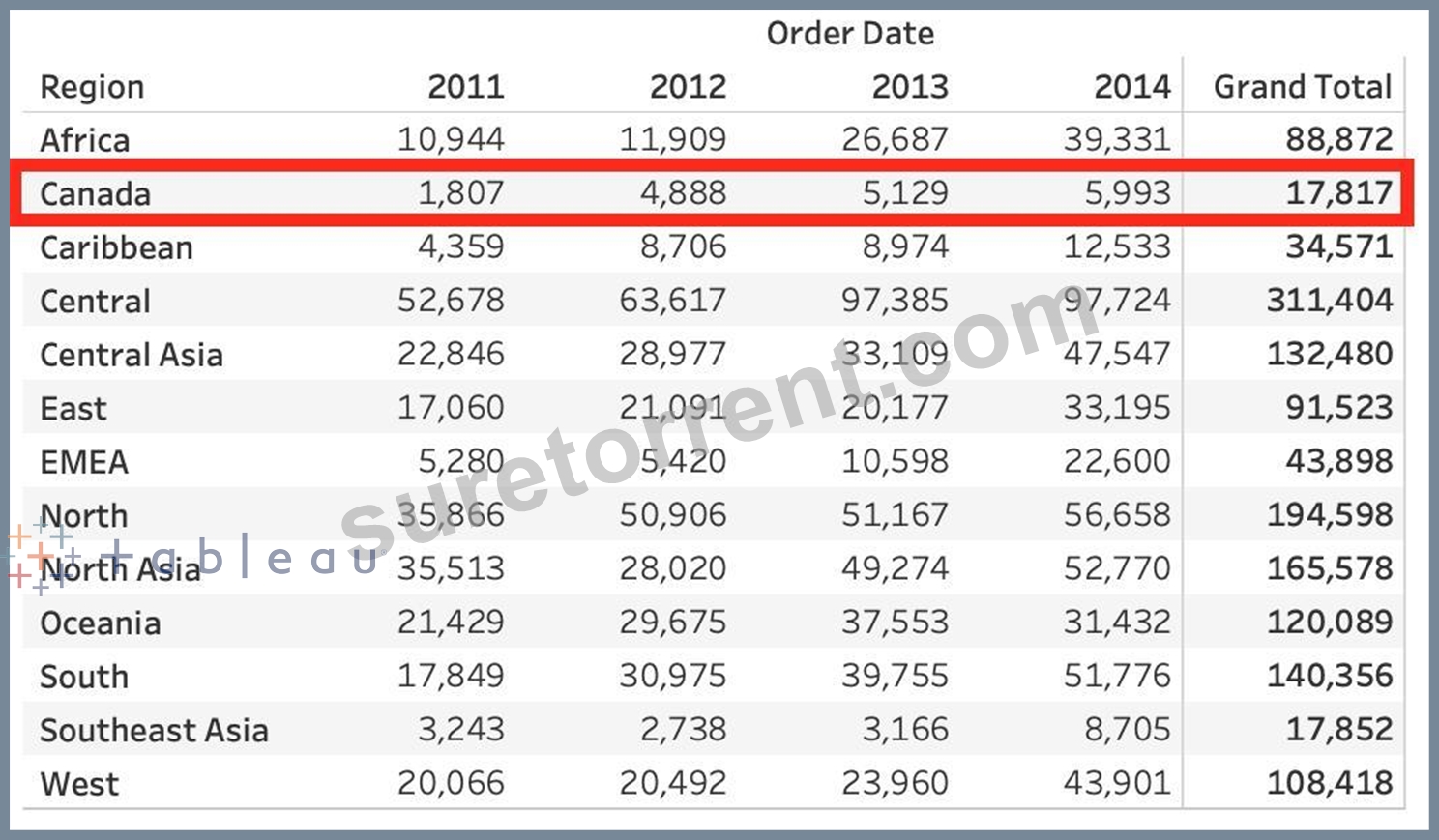
You could also Filter by Region to only Focus on Canada, but that's your choice: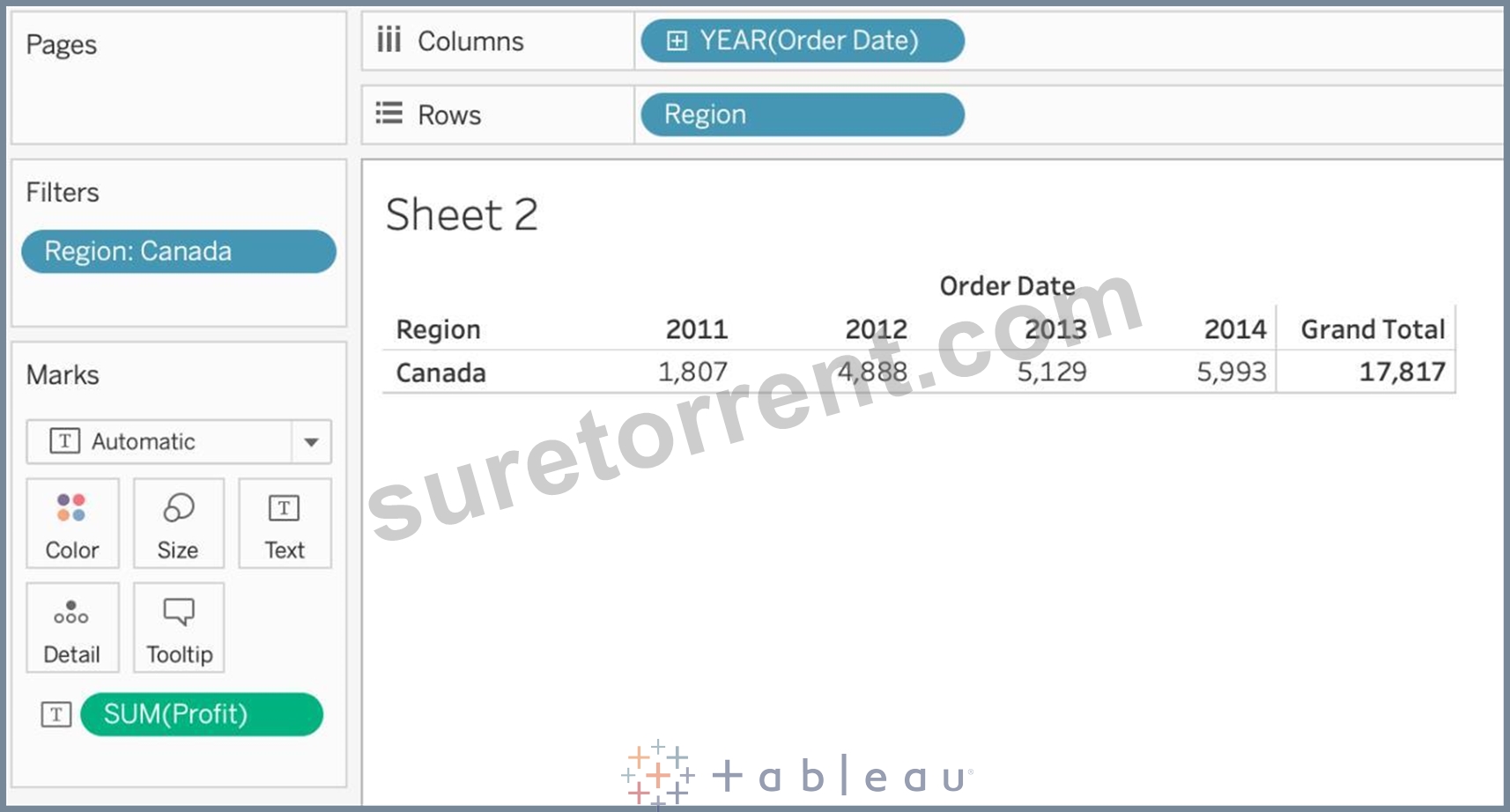
THEREFORE,
2012 = 4,888
2011 -> 2014 = 17,817
NEW QUESTION 64
Skipped Join the Geo Data and Time Series Table on the Item Number ID column, and display the Store count for every State on a Map. What was the Store count in 2017 for Texas (TX)?
Join the Geo Data and Time Series Table on the Item Number ID column, and display the Store count for every State on a Map. What was the Store count in 2017 for Texas (TX)?
- A. 592,593
- B. 293,202
- C. 416,702
- D. 336,908
Answer: C
Explanation:
Explanation
Since you need BOTH State and the YEAR, we need to use an Inner Join.
Follow the steps below:
NEW QUESTION 65
......
Updated PDF (New 2022) Actual Tableau Desktop-Specialist Exam Questions: https://www.suretorrent.com/Desktop-Specialist-exam-guide-torrent.html
Dumps Moneyack Guarantee - Desktop-Specialist Dumps Approved Dumps: https://drive.google.com/open?id=1OUkeZjBGNIMyisFfkoz7B8WIc-jFdcwZ