

Latest Success Metrics For Actual 1z1-071 Exam 2024 Realistic Dumps
Updated 1z1-071 Dumps Questions For Oracle Exam
Oracle 1z1-071 Exam consists of 73 multiple-choice questions that must be completed in 100 minutes. The questions are designed to test the candidate's understanding of SQL and its various functions. 1z1-071 exam covers topics such as creating and managing tables, manipulating data, using SQL functions, and controlling user access to data. 1z1-071 exam also covers the basics of SQL syntax and how to write SQL statements.
To prepare for this certification exam, candidates should have a good understanding of SQL programming concepts, such as data types, operators, functions, and control structures. They should also be familiar with basic database concepts, such as normalization, indexing, and transaction management. 1z1-071 exam consists of 73 multiple-choice questions, which need to be completed within 100 minutes. The passing score for 1z1-071 exam is 63%. Upon successful completion of the exam, candidates will be awarded the Oracle Database SQL certification, which is a valuable credential for anyone seeking to advance their career in database management.
Preparing for the Oracle 1z1-071 exam takes time and effort. Candidates should review the exam objectives, study SQL syntax and concepts, and practice writing and executing SQL statements. There are also many resources available online, including Oracle documentation, study guides, and practice exams, that can help candidates prepare for the exam.
NEW QUESTION # 90
View the exhibits and examine the structures of the COSTS and PROMOTIONS tables.

Evaluate the following SQL statement:
What would be the outcome of the above SQL statement?
- A. It displays prod IDs in the promos with the lowest cost in the same time interval.
- B. It displays prod IDs in the promos which cost less than the highest cost in the same time interval.
- C. It displays prod IDs in the promos with the highest cost in the same time interval.
- D. It displays prod IDs in the promo with the lowest cost.
Answer: B
NEW QUESTION # 91
View the Exhibit and examine the structure of CUSTOMERStable.
Evaluate the following query:
Which statement is true regarding the above query?
- A. It produces an error because conditions on the CUST_CREDIT_LIMITcolumn are not valid.
- B. It produces an error because the condition on the CUST_FIRST_NAMEcolumn is not valid.
- C. It executes successfully.
- D. It produces an error because the condition on the CUST_CITYcolumn is not valid.
Answer: C
NEW QUESTION # 92
Examine this statement:
SELECT cust_id, cust^last_ndma "Last Name"
FROM customers
WHERE country_id - 10 UNION
SELECT cust_ID_CUST_NO, cust_last_name
PROM customers
WHERE country__id = 30
Identify three order by clauses, any one of which will complete the query successfully.
- A. ORDER BY "Last Name
- B. ORDER BY "CUST^NO
- C. ORDER BY 2. cust _id
- D. ORDER BY CUST_NO
- E. ORDER BY 2,
Answer: A,C,E
NEW QUESTION # 93
Examine the description of the ORDERS table:
Which three statements execute successfully?
- A. SELECT * FROM orders
MINUS
SELECT * FROM INVOICES ORDER BY 1 - B. (SELECT * FROM orders
UNION ALL
SELECT* FROM invoices) ORDER BY order _id; - C. SELECT order_ id, invoice_ data order_ date FROM orders
MINUS
SELECT invoice_ id, invoice_ data FROM invoices ORDER BY invoice_ id; - D. SELECT * FROM orders ORDER BY order_ id
UNION
SELECT * FROM invoices; - E. SELECT order_ id, order_ data FROM orders
UNION ALL
SELECT invoice_ id, invoice_ data FROM invoices ORDER BY order_ id; - F. SELECE order _id, order _ date FRON orders
LNTERSECT
SELECT invoice_ id, invoice_ id, order_ date FROM orders - G. SELECT * FROM orders ORDER BY order_ id
INTERSEOT
SELECT * FROM invoices ORDER BY invoice_ id;
Answer: B,D,E
Explanation:
In Oracle SQL, set operations like UNION, UNION ALL, INTERSECT, and MINUS can be used to combine results from different queries:
* Option A:
* Combining results using UNION ALL followed by ORDER BY will execute successfully because UNION ALL allows duplicate rows and ORDER BY can be used to sort the combined result set.
* Option E:
* Similar to option A, UNION ALL combines all rows from the two selects and allows ordering of the results.
* Option G:
* UNION combines the results from two queries and removes duplicates, and ORDER BY can be used to sort the final result set.
Options B, C, D, and F are incorrect because:
* Option B: You cannot intersect different columns (ORDER_ID with INVOICE_ID).
* Option C: Incorrect column names and syntax with ORDER BY.
* Option D: ORDER BY cannot be used before a set operator like INTERSECT.
* Option F: ORDER BY cannot be used directly after a MINUS operator without wrapping the MINUS operation in a subquery.
NEW QUESTION # 94
Examine the structure of the ORDERS table: (Choose the best answer.)
You want to find the total value of all the orders for each year and issue this command:
SQL> SELECT TO_CHAR(order_date,'rr'), SUM(order_total) FROM orders
GROUP BY TO_CHAR(order_date, 'yyyy');
Which statement is true regarding the result?
- A. It return an error because the datatype conversion in the SELECT list does not match the data type conversion in the GROUP BY clause.
- B. It executes successfully but does not give the correct output.
- C. It returns an error because the TO_CHAR function is not valid.
- D. It executes successfully but gives the correct output.
Answer: A
NEW QUESTION # 95
Examine the description of the CUSTOMERStable:
You need to display last names and credit limits of all customers whose last name starts with A or B in lower or upper case, and whose credit limit is below 1000.
Examine this partial query:
Which two WHEREconditions give the required result? (Choose two.)
- A.

- B.

- C.

- D.

- E.

Answer: D,E
NEW QUESTION # 96
View the Exhibit and examine the structure of the ORDERS table. The ORDER_ID column is the PRIMARY KEY in the ORDERS table.
Evaluate the following CREATE TABLE command:
CREATE TABLE new_orders(ord_id, ord_date DEFAULT SYSDATE, cus_id)
AS
SELECT order_id.order_date,customer_id
FROM orders;
Which statement is true regarding the above command?
- A. The NEW_ODRDERS table would not get created because the DEFAULT value cannot be specified in the column definition.
- B. The NEW_ODRDERS table would not get created because the column names in the CREATE TABLE command and the SELECT clause do not match.
- C. The NEW_ODRDERS table would get created and all the constraints defined on the specified columns in the ORDERS table would be passed to the new table.
- D. The NEW_ODRDERS table would get created and only the NOT NULL constraint defined on the specified columns would be passed to the new table.
Answer: D
NEW QUESTION # 97
Examine the description of the EMPLOYEES table:
Which two queries return rows for employees whose manager works in a different department?
- A. SELECT emp.*
FROM employees emp
WHERE NOT EXISTS (
SELECT NULL
FROM employees mgr
WHERE emp.manager id = mgr.employee_ id
AND emp.department_id<>mgr.department_id
); - B. SELECT emp. *
FROM employees emp
RIGHT JOIN employees mgr
ON emp.manager_ id = mgr. employee id
AND emp. department id <> mgr.department_ id
WHERE emp. employee_ id IS NOT NULL; - C. SELECT emp.*
FROM employees emp
LEFT JOIN employees mgr
ON emp.manager_ id = mgr.employee_ id
AND emp. department id < > mgr. department_ id; - D. SELECT emp. *
FROM employees emp
JOIN employees mgr
ON emp. manager_ id = mgr. employee_ id
AND emp. department_ id<> mgr.department_ id; - E. SELECT emp. *
FROM employees emp
WHERE manager_ id NOT IN (
SELECT mgr.employee_ id
FROM employees mgr
WHERE emp. department_ id < > mgr.department_ id
);
Answer: A,D
Explanation:
To find employees whose manager works in a different department, you can use a subquery or a join that compares the DEPARTMENT_ID of the employee with the DEPARTMENT_ID of their manager.
A). This query is incorrect because the NOT IN subquery incorrectly attempts to compare EMPLOYEE_ID with MANAGER_ID, and the correlation condition inside the subquery is incorrect.
B). This query is correct. The NOT EXISTS clause correctly identifies employees whose MANAGER_ID matches the EMPLOYEE_ID of another employee (mgr) and where the DEPARTMENT_ID differs from that manager's DEPARTMENT_ID.
C). This query is incorrect because the LEFT JOIN will return all employees, and there is no WHERE clause to filter out those employees whose managers are in the same department.
D). This query is incorrect. The RIGHT JOIN does not ensure that the resulting rows are for employees whose manager works in a different department. It also returns all managers, which is not the requirement.
E). This query is correct. The JOIN ensures that the returned rows are for employees (emp) whose MANAGER_ID matches the EMPLOYEE_ID of managers (mgr), and it correctly filters to include only those employees whose DEPARTMENT_ID is different from their manager's DEPARTMENT_ID.
NEW QUESTION # 98
Examine these statements executed in a single Oracle session:
CREATE TABLE product (pcode NUMBER(2),pname VARCHAR2(20));
INSERT INTO product VALUES(1,'pen');
INSERT INTO product VALUES (2,'pencil');
INSERT INTO product VALUES(3,'fountain pen');
SAVEPOINT a;
UPDATE product SET pcode=10 WHERE pcode =1;
COMMIT;
DELETE FROM product WHERE pcode =2;
SAVEPOINT b;
UPDATE product SET pcode=30 WHERE pcode =3;
SAVEPOINT c;
DELETE FROM product WHERE pcode =10;
ROLLBACK TO SAVEPOINT b;
COMMIT;
Which three statements are true
- A. The code for pen is 10.
- B. There is no row containing fountain pen.
- C. The code for fountain pen is 3
- D. The code for pen is 1.
- E. There is no row containing pen
- F. There is no row containing pencil.
Answer: A,E,F
Explanation:
* After creation and initial inserts, the pcode for 'pen' is updated to 10, and then committed.
* The 'pencil' row is deleted and not yet committed.
* A savepoint b is set after the deletion of the 'pencil' row.
* The 'fountain pen' pcode is updated to 30, followed by setting savepoint c.
* The 'pen' row (now with pcode 10) is deleted.
* A rollback to savepoint b reverts the deletion of 'pen' and the update to 'fountain pen', but not the deletion of 'pencil', which was committed earlier due to the scope of the savepoint.
* Therefore, after the final commit:
* A: The code for 'pen' is 10, since the update was committed and the subsequent delete was rolled back.
* C: There is no row containing 'pencil' because its deletion was committed.
* F: There is a row containing 'pen' because the deletion was rolled back to savepoint b which was set after the deletion of 'pencil'.
NEW QUESTION # 99
Examine the structure of the MARKS table:
Which two statements would execute successfully? (Choose two.)
- A. SELECT student_name subject1FROM marksWHERE subject1 > AVG(subject1);
- B. SELECT student_name,SUM(subject1)FROM marksWHERE student_name LIKE 'R%';
- C. SELECT SUM(DISTINCT NVL(subject1,0)), MAX(subject1)FROM marksWHERE
subject1 > subject2; - D. SELECT SUM(subject1+subject2+subject3)FROM marksWHERE student_name IS NULL;
Answer: C,D
NEW QUESTION # 100
Examine the following query:
SQL> SELECT prod_id, amount_sold
FROM sales
ORDER BY amount_sold
FETCH FIRST 5 PERCENT ROWS ONLY;
What is the output of this query?
- A. It displays 5 percent of the products with the lowest amount sold.
- B. It results in an error because the ORDER BYclause should be the last clause.
- C. It displays 5 percent of the products with the highest amount sold.
- D. It displays the first 5 percent of the rows from the SALEStable.
Answer: A
Explanation:
Explanation/Reference:
References:
https://oracle-base.com/articles/12c/row-limiting-clause-for-top-n-queries-12cr1
NEW QUESTION # 101
Which statement is true regarding external tables?
- A. The CREATE TABLE AS SELECT statement can be used to upload data into a normal table in the database from an external table.
- B. The default REJECT LIMIT for external tables is UNLIMITED.
- C. ORACLE_LOADER and ORACLE_DATAPUMP have exactly the same functionality when used with an external table.
- D. The data and metadata for an external table are stored outside the database.
Answer: A
Explanation:
Explanation
https://docs.oracle.com/cd/B28359_01/server.111/b28310/tables013.htm
NEW QUESTION # 102
Examine the description of the ORDERStable:
Examine the description of the INVOICEStable:
Examine this query:
Which three rows will it return? (Choose three.)
5 01-MAR-2019
- A. 4 01-FEB-2019
- B. 1 <null>
- C. 3 01-JAN-2019
- D. 2 <null>
- E. 3 <null>
- F.
- G. 5 <null>
Answer: E,F,G
NEW QUESTION # 103
Examine the data in the ENPLOYEES table:
Which statement will compute the total annual compensation tor each employee?
- A. SELCECT last_namo, (monthly_salary * 12) + (menthy_salary * 12 * monthly_commission_pct)
AS annual_comp FROM employees - B. SECECT last_namo, (menthy_salary + monthly_commission_pct) * 12 AS annual_comp
FROM employees; - C. SELCECT last_namo, (monthly_salary * 12) + (menthy_salary * 12 * NVL
(monthly_commission_pct, 0)) AS annual_comp FROM employees - D. SELCECT last_namo, (monthly_salary * 12) + (monthly_commission_pct * 12) AS annual_comp
FROM employees
Answer: C
NEW QUESTION # 104
In the customers table, the CUST_CITY column contains the value 'Paris' for the CUST_FIRST_NAME 'Abigail'.
Evaluate the following query:
What would be the outcome?
- A. Abigail Pa
- B. Abigail PA
- C. An error message
- D. Abigail IS
Answer: A
NEW QUESTION # 105
Examine this SQL statement:
Which two are true?
- A. The subquery is not a correlated subquery.
- B. The UPDATE statement executes successfully even if the subquery selects multiple rows.
- C. The subquery is executed for every updated row in the ORDERS table.
- D. All existing rows in the ORDERS table are updated.
- E. The subquery is executed before the UPDATE statement is executed.
Answer: C,E
Explanation:
The provided SQL statement is an update statement that involves a subquery which is correlated to the main query.
* A. The subquery is executed before the UPDATE statement is executed. (Incorrect) This statement is not accurate in the context of correlated subqueries. A correlated subquery is one where the subquery depends on values from the outer query. In this case, the subquery is executed once for each row that is potentially updated by the outer UPDATE statement because it references a column from the outer query (o.customer_id).
* B. All existing rows in the ORDERS table are updated. (Incorrect)
Without a WHERE clause in the outer UPDATE statement, this would typically be true. However, the correctness of this statement depends on the actual data and presence of matching customer_id values in both tables. If there are rows in the ORDERS table with customer_id values that do not exist in the CUSTOMERS table, those rows will not be updated.
* C. The subquery is executed for every updated row in the ORDERS table. (Correct) Because the subquery is correlated (references o.customer_id from the outer query), it must be executed for each row to be updated in the ORDERS table to get the corresponding cust_last_name from the CUSTOMERS table.
NEW QUESTION # 106
Examine this statement:
On which two columns of the table will an index be created automatically?
- A. PRODUCT_ID
- B. SERIAL_NO
- C. ORDER_ID
- D. STATUS
- E. ORDER_TOTAL
- F. ORDER_DATE
Answer: B,C
NEW QUESTION # 107
Examine the description of the SALES1 table: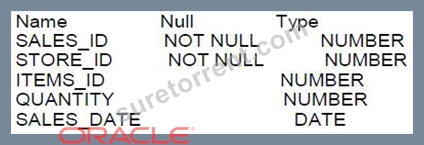
SALES2 is a table with the same description as SALES1,
Some sales data is duplicated In both tables.
You want to display the rows from the SALES1 table which are not present in the SALIES2 table.
Which set operator generates the required output?
- A. UNION ALL
- B. MINUS
- C. UNION
- D. INTERSECT
- E. SUBTRACT
Answer: B
NEW QUESTION # 108
Examine the description of the PRODUCTS table:
Which two statements execute without errors?
- A. MERGE INTO new_prices n
USING (SELECT * FROM products WHERE cost>150) p
ON (n.prod_id= p.prod_id)
WHEN MATCHED THEN
DELETE WHERE (p.cost<200) - B. MERGE INTO new_prices n
USING (SELECT * FROM products) p
WHEN MATCHED THEN
UPDATE SET n.price= p.cost* 01
WHEN NOT MATCHED THEN
INSERT(n.prod_id, n.price) VALUES(p.prod_id, cost*.01)
WHERE(p.cost<200); - C. MERGE INTO new_prices n
USING products p
ON (p.prod_id =n.prod_id)
WHEN NOT MATCHED THEN
INSERT (n.prod _id, n.price) VALUES (p.prod_id, cost*.01)
WHERE (p.cost<200); - D. MERGE INTO new_prices n
USING (SELECT * FROM products WHERE cost>150) p
ON (n.prod_id= p.prod_id)
WHEN MATCHED THEN
UPDATE SET n.price= p.cost*.01
DELETE WHERE (p.cost<200);
Answer: D
Explanation:
B: True. This MERGE statement should execute without errors. It uses a conditionally filtered selection from the products table as a source to update or delete rows in the new_prices table based on whether the prod_id matches and the cost is greater than 150. The delete operation within a MERGE statement is allowed in Oracle when a WHEN MATCHED clause is specified.
The MERGE statement is correctly structured with a USING clause that includes a subquery with a valid WHERE condition, an ON condition that specifies how to match rows between the source and the target, and a WHEN MATCHED THEN clause that specifies the update and delete operations based on the cost condition.
References:Oracle SQL documentation specifies that within a MERGE statement, you can specify a WHEN MATCHED clause to update and/or delete rows in the target table based on the condition specified after the DELETE keyword.
NEW QUESTION # 109
......
Full 1z1-071 Practice Test and 323 Unique Questions, Get it Now!: https://www.suretorrent.com/1z1-071-exam-guide-torrent.html
Best Value Available Preparation Guide for 1z1-071 Exam: https://drive.google.com/open?id=1PKLZtIU_ryfaQrKevxK9FffzjfqDUXW4